

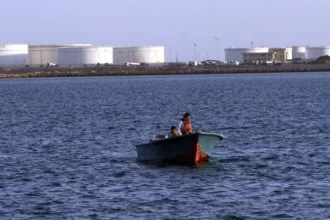
Tension in the Gulf: Oman postpones key summit on the Strait of Hormuz
The Government of Oman has officially announced the temporary suspension of the regional meeting that was scheduled for this Monday in the city of Salalah. The meeting’s fundamental purpose was to analyze the complex situation in the Strait of Hormuz and establish diplomatic mechanisms to ensure the safety of navigation in this strategic maritime route for global energy trade.
Badr Albusaidi, the Foreign Minister of Oman, was in charge of making the news official through his digital channels. The diplomat stressed that this strategic pause responds to the need to protect the possibilities of reaching a solid consensus among all the nations involved, reaffirming his country’s commitment as a neutral mediator in the search for solutions to regional tensions.
In the interest of consensus, the regional meeting scheduled for tomorrow in Salalah has been postponed.
Badr Albusaidi, Foreign Minister of Oman
Iranian conditions and the impact on navigation
The meeting sought to bring together delegations from Iran, Saudi Arabia, Kuwait, Qatar, the United Arab Emirates, and Iraq, although the confirmed absence of Bahrain already signaled a complex landscape. The background to the postponement lies in the marked divergences over the conditions for maritime transit.
Iran’s Foreign Minister, Abbas Araghchi, has been emphatic in pointing out that any dialogue with Oman does not constitute an immediate reopening of the strait. Tehran maintains as a non-negotiable condition that the United States resume compliance with the commitments established in the Islamabad Memorandum, signed in June. This document directly links the stability of Hormuz to:
- The cessation of hostilities and the lifting of the U.S. naval blockade.
- The review of oil sanctions imposed against Iran.
- The release of Iranian funds currently frozen abroad.
A critical point for the energy market
The Strait of Hormuz is not just a maritime passage, but the lung of the global energy market. Historically, nearly a fifth of the oil traded in the world transits through this area, which makes any disruption in the region a factor of international economic instability.
While Omani diplomacy attempts to chart safe routes, positions from Washington remain distant. During his recent visit to Ireland, President Donald Trump downplayed the relevance of this summit, declaring that the situation depends exclusively on the parties involved and suggesting that the U.S. presence in the region could eventually be limited only to energy resource issues.
At the moment, a new date to resume talks has not been set, keeping the future of one of the most watched and disputed maritime routes on the planet in suspense.


