Citizen security in the Dominican Republic: Real decline or perception crisis?
In the Dominican Republic, official figures and the reality experienced by citizens on the streets seem to walk along different paths. While the authorities highlight a constant reduction in crime rates, the perception of insecurity remains one of the population’s greatest concerns, generating a debate over whether the problem is subsiding or if it has simply mutated in its modalities.
Official figures versus daily reality
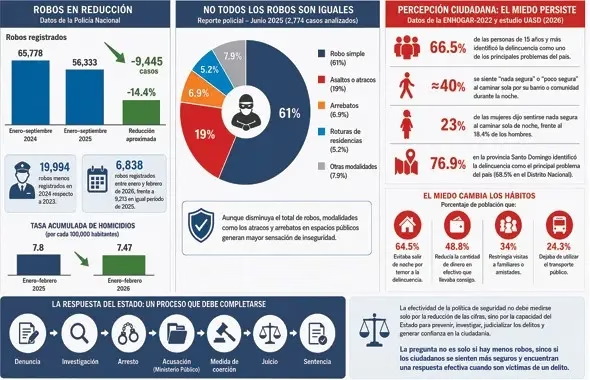
According to National Police reports, the numbers reflect a decrease in criminal activity. During the year 2024, 19,994 fewer robberies were recorded compared to the previous period. This trend continued during 2025, where up to the month of September, 56,333 cases were registered, which represents a 14.4% decrease compared to the 65,778 complaints filed in the same period of 2024.
However, the impact is not uniform. According to a June 2025 analysis, 61% of classified crimes were simple thefts, while 19% corresponded to assaults or robberies and 6.9% to snatch thefts. It is precisely this last category, along with robberies, that generates the greatest vulnerability and fear in public spaces, regardless of the fact that the total volume of thefts has decreased.
Statistics measure reported facts, but public perception is fueled by personal experiences, the social environment, and trust in the justice system.
The impact on lifestyle
Fear has begun to alter the habits of Dominicans. Recent studies by the UASD Institute for Socioeconomic Research indicate that 64.5% of people avoid going out at night, while a significant segment of the population has stopped using public transport or has restricted visits to relatives as a precaution. This sense of insecurity is more pronounced in women and is accentuated in areas such as the Santo Domingo province, where almost 77% of residents point to crime as a critical problem.
Pending challenges in the judicial system
- The dark figure: Many crimes are not part of official statistics because victims, out of distrust or fear, choose not to file a formal complaint.
- Procedural effectiveness: The success of security policy is not limited to arrests, but depends on a process that ranges from investigation to judicial sentencing.
- Perception vs. Reality: Citizen security remains a top-tier political challenge, with more than half of the population negatively evaluating current efforts in this area.
In short, although statistical data show a reduction in robbery records and a slight decrease in the homicide rate for 2026, the gap between security management and citizen peace of mind remains open, driven by the need for greater trust in institutions and the effective response of the justice system to crime.