The battle against the clock: Time becomes the protagonist in corruption cases in the Dominican Republic
The judicial proceedings for alleged acts of administrative corruption that have captured the country’s attention in recent years face a challenge that goes beyond the guilt or innocence of those involved: the time factor. The concept of the statute of limitations for criminal action has gained ground in the courts, becoming the center of a legal dispute where it is debated whether the prolongation of case files violates the right to a trial within a reasonable time.
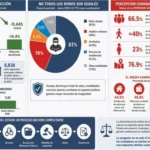
While the technical defense teams insist that the timeline has exceeded legal limits, the Public Prosecutor’s Office maintains that the complexity, the volume of evidence, and the number of defendants justify the duration of the cases. According to records from the Supreme Court of Justice, 157,562 cases have been brought to trial in the last five years, of which 7,825 have concluded through the extinction of criminal action.
Coral and Coral 5G: A trial marked by complexity
The Coral case, unified with its 5G aspect, represents one of the most voluminous proceedings in recent judicial history. After years of hearings and a rigorous preliminary stage, the trial on the merits began in June 2024. Despite attempts by the defense teams of several former officials and military personnel to declare the extinction of the process, the judges have dismissed such requests.
- Procedural volume: 36 defendants, 319 testimonies, and more than 4,000 pieces of documentary evidence.
- Sentence: On June 15, 2026, sentences of up to 20 years were handed down for key figures such as Adán Cáceres Silvestre and Juan Carlos Torres Robiou.
- Current status: The process is in the final phase of the full reading of the sentence.
Medusa and the debate about the start date
In the Medusa case, which involves former attorney general Jean Alain Rodríguez, the controversy over time has been constant. Although the court determined that the legal deadline had been exceeded by counting more than five years since the first migration alert, this did not result in an automatic extinction.
For the court, the assessment of the complexity of the case file and the numerous procedural incidents, such as recusals and changes of lawyers, prevail over the simple mathematical count of the days elapsed.
Squid: The technical dispute over the calculation of the deadline
The Calamar case presents a particular edge: the discrepancy over when the deadline count actually began. While the Public Prosecutor’s Office points to the public presentation of the operation in 2023, the defense teams argue that the process began in February 2022 with prior actions regarding the assets of those under investigation.
Although the process has managed to advance to the trial stage against 35 people, figures such as Ángel Lockward have kept the request for dismissal on the agenda of the Third Collegiate Court. The case continues its course, keeping under scrutiny high-profile figures who were former ministers and officials of the previous administration.
The legal perspective: When is it excessive?
Criminal law experts, such as Jean Cristofer Pérez, point out that the judicial system must differentiate between delays attributable to the State and those that are part of the legitimate right to a defense. The key lies in identifying whether the delay is an obstructionist tactic or a natural consequence of large-scale proceedings. Alofoke Deportes will continue to follow these decisions that define the course of Dominican justice.