Pelegrín Castillo proposes state of emergency at the border in light of the Haitian crisis
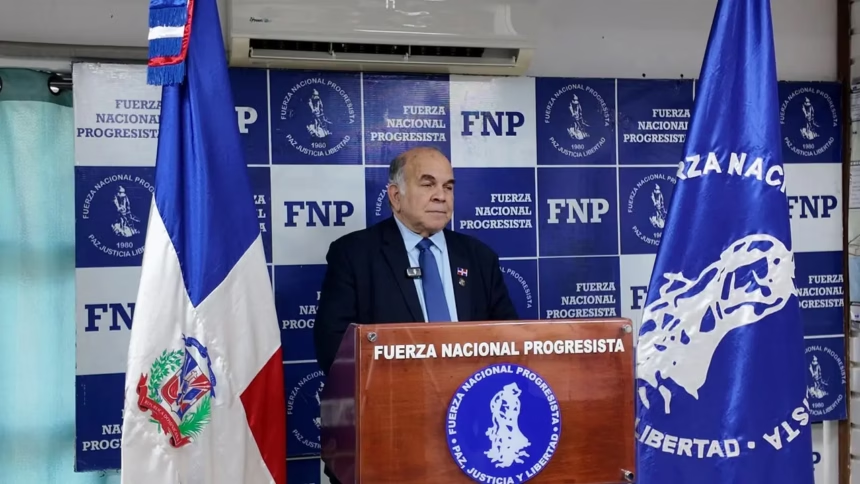
The president of the National Progressive Force (FNP), Pelegrín Castillo, has formally requested that the Dominican government implement a state of emergency in the border zone. This measure, according to the political leader, is necessary to shield national security in the face of the worsening crisis in Haiti, which he considers a latent threat to regional stability.
One of the points of greatest concern raised by Castillo is the possible spread of diseases. The leader warned about an alleged anthrax outbreak in Haitian territory, noting that the entry of this pathology into the Dominican Republic would be devastating, given that the country has historically remained free of this ailment.
Questions regarding the Haitian electoral process
During his speech, Castillo was emphatic in pointing out that the minimum conditions do not exist to carry out free and transparent elections in Haiti, scheduled for the month of December. Based on reports regarding the links between political actors and criminal structures, the leader urged the Dominican State to distance itself from what he described as an electoral masquerade and to adopt a sovereign and firm stance.
The defense of our border must be the pillar of the national security strategy. The solution to the Haitian crisis lies in the reconstruction of its own institutions, without that responsibility falling on the shoulders of the Dominican Republic.
Pelegrín Castillo, President of the FNP
Strategic reviews: DR-Cafta and technological sovereignty
In the realm of international relations, Castillo called on the U.S. administration to reevaluate existing trade agreements, specifically DR-Cafta. The leader emphasized the need to protect local agricultural production, with special attention to the rice sector, which he considers a vital element for the country’s food security and sovereignty.
Likewise, Castillo suggested that highly sensitive projects, such as the implementation of 5G technology and digital wallet systems, should be subject to rigorous scrutiny by the National Security and Defense Council, as well as the Constitutional Court, in order to avoid vulnerabilities in the State’s critical infrastructure.
Regional stance and rejection of impositions
The Latin American Union of Parties (UPLA) endorsed Castillo’s vision through a resolution that defines the Haitian crisis as a risk to the collective security of the continent. The organization proposed the creation of the “Shield of the Americas,” a regional defense architecture designed to combat transnational crime.
- Rejection of the mandatory teaching of Creole in Dominican schools.
- Demand that the international community focus humanitarian and political aid within Haitian territory.
- Emphasis on the frontal fight against arms trafficking and criminal networks that destabilize the region.
Finally, Castillo reiterated that the Dominican Republic must not become a containment zone for a crisis it did not originate, reaffirming that the stability of the region depends on a coordinated international intervention that prioritizes the strengthening of the rule of law in Haiti.