

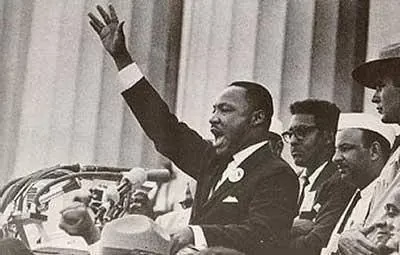
The legacy of Martin Luther King Jr.: 63 years after the historic “I Have a Dream” speech
August 28, 1963, was marked in history books as the day Martin Luther King Jr. changed the course of the fight for civil rights. In front of a crowd of 250,000 people at the Lincoln Memorial, Washington, his message of equality and justice resonated with a force that transcended American borders, becoming a global standard against racial segregation.
A mobilization for freedom and work
The March on Washington for Jobs and Freedom was not just an act of protest, but a collective demand for a more equitable future. The protesters demanded an end to employment discrimination, wage improvements, educational integration, and, above all, real guarantees for the exercise of the right to vote. Led by figures such as A. Philip Randolph and organized with the key support of Bayard Rustin, the day united unions, religious groups, and activists in a peaceful demonstration of national unity.
I have a dream: that my four little children will one day live in a nation where they will not be judged by the color of their skin but by the content of their character.
Martin Luther King Jr.
The improvised origin of a universal speech
Although the speech is world-renowned for the phrase “I Have a Dream,” its creation had a component of spontaneity. King began his intervention following a prepared script, but halfway through, he decided to depart from the manuscript to connect with the audience from a deeply personal vision. This decision to improvise on the fly turned a political text into a timeless message about human hope.
The impact on legislation and social change
- Civil Rights Act (1964): Prohibited discrimination and segregation in public and workplace spaces.
- Voting Rights Act (1965): Eliminated the barriers that prevented the African American population from participating in electoral processes.
While these legal changes did not eradicate inequalities overnight, they represented a necessary turning point to dismantle the segregation laws that prevailed in the southern United States. King’s work was recognized with the Nobel Peace Prize in 1964, making him, at 35 years old, the youngest laureate in history up to that time.
A symbol that endures
King’s trajectory ended tragically on April 4, 1968, when he was assassinated in Memphis while supporting a sanitation workers’ strike. Despite his untimely departure, the impact of that August 28, 1963, remains relevant. Today, his words are remembered as the foundation of any movement that seeks equality, demonstrating that building a fairer society begins with the ability to imagine it.


