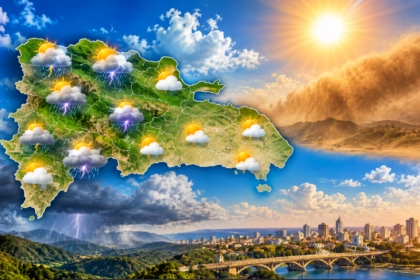
Weather conditions in the Dominican Republic: Saharan dust and high pressure dominate the forecast
The Dominican Institute of Meteorology (Indomet) has reported that atmospheric conditions across much of the national territory will be marked this Friday by the influence of a high-pressure system. This phenomenon, combined with the presence of Saharan dust particles, will act as a determining factor in limiting the occurrence of significant rainfall in various regions of the country.
Despite this landscape of stability, the meteorological agency warns that daytime heating, combined with the moisture transport generated by the east/southeast wind, will cause changes during the afternoon. The formation of cloudiness is expected, which will give way to local downpours, occasionally accompanied by isolated thunderstorms.
Provinces under surveillance for possible showers
Although much of the day will remain with little precipitation, meteorological authorities have identified the areas where rain is most likely to occur towards the afternoon and early evening hours:
- Hato Mayor
- Monte Plata
- Santiago
- Santiago Rodriguez
- Dajabon
Regarding Greater Santo Domingo, skies with scattered cloudiness are expected in the National District and Santo Domingo Oeste, while a partly cloudy environment will prevail in Santo Domingo Norte and Este. Temperatures will remain hot, with lows between 24 °C and 26 °C, and highs that will range between 33 °C and 35 °C.
Monitoring cyclonic activity
In the field of international meteorology, Indomet is keeping two tropical systems under observation, although both are outside our area of influence:
- Tropical Storm Fay: Located 1,715 kilometers west/southwest of the Azores, with maximum winds of 85 km/h. It is moving west at 9 km/h.
- Tropical Storm Gonzalo: Located 220 kilometers south of the Cape Verde Islands, with winds of 75 km/h and moving north/northwest at 15 km/h.
Due to their geographical position and current trajectory, none of these atmospheric phenomena pose a danger to the Dominican Republic, allowing the country to focus on the influence of Saharan dust and the high-pressure system as the predominant climatic factors.