
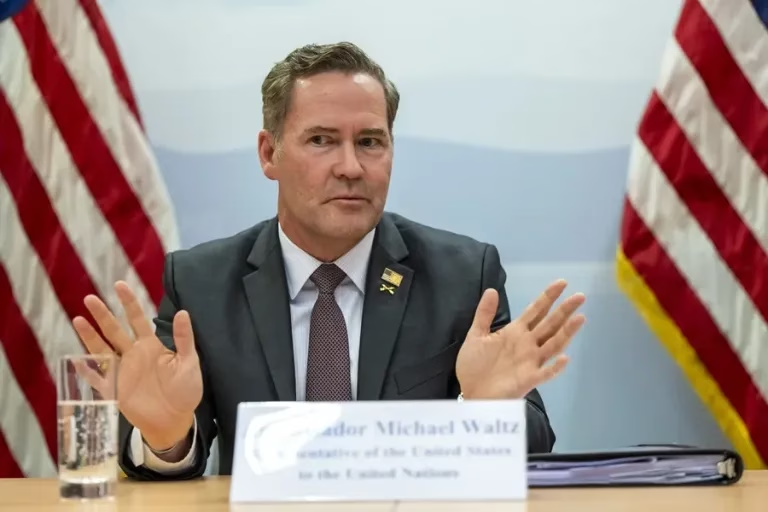
Tension in Washington: Mike Waltz supports press access restrictions imposed by Trump
The United States Ambassador to the United Nations, Mike Waltz, has come to the defense of President Donald Trump’s recent decision to restrict access to the White House for media outlets such as CNN, MS NOW, and Politico. During a public appearance, Waltz maintained that the president possesses the necessary authority to limit the entry of journalists into government facilities when he considers that the exercise of their work is not carried out under principles of good faith.
To support this position, the diplomat alluded to historical judicial precedents, specifically citing the 1965 case Zemel v. Rusk. On that occasion, the Supreme Court determined that the constitutional right to free speech and publication does not imply unrestricted access to information gathering under any circumstances.
The president is well within his rights to limit journalists’ access to government facilities, especially when, in his opinion, they are not acting in good faith.
Mike Waltz, U.S. Ambassador to the UN
The looming legal conflict
Despite the official argumentation, the legal landscape is complex. Constitutional law experts point out that there are conflicting rulings, such as the 1977 case Sherrill v. Knight, which establishes that any denial of press credentials must be based on clear and defined criteria, avoiding arbitrariness at all times.
Given this scenario, the affected media outlets are expected to initiate immediate legal action. According to press freedom specialists, the legal representatives of the media groups will seek to obtain court orders or temporary injunctions to ensure that briefings continue to operate under standard practices.
Rejection from the journalistic guild
The response from the White House Correspondents’ Association (WHCA) was swift. The guild has described the measure as a direct attack on the free press, reiterating that the First Amendment of the U.S. Constitution protects journalistic work against any type of government interference. The debate over the balance between national security and the right to information continues to be the central axis of this dispute in Washington.