Dominicans First: Santiago Matías’ challenge to transform followers into votes for 2028
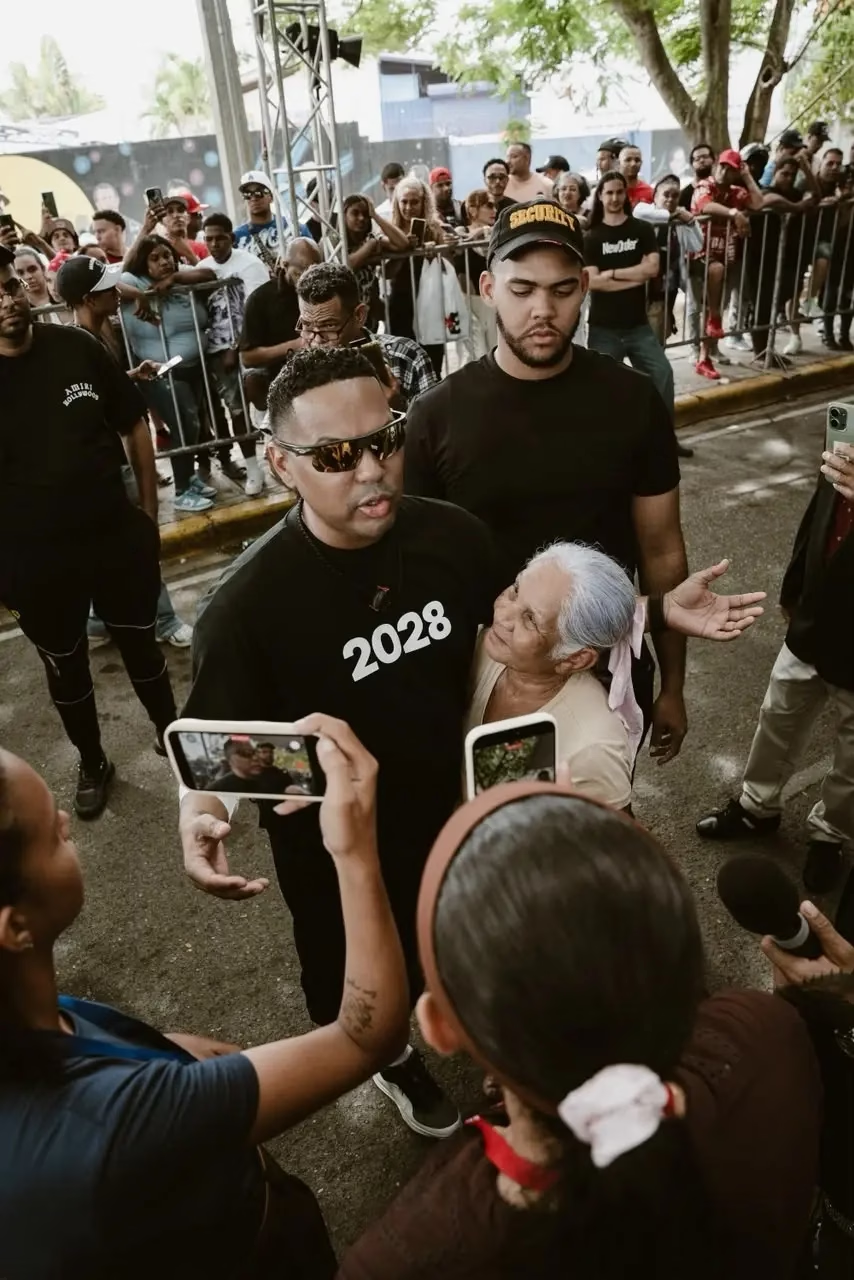
The political project Dominicanos Primero, led by Santiago Matías, has entered a decisive phase. After consolidating a massive digital community and a proven track record in media, the organization faces the challenge of translating that reach into the electoral arena, with its sights set on the 2028 elections. The big question posed in the political landscape is whether this notoriety can effectively translate into a territorial structure, active militancy, and, ultimately, votes.
Currently, the movement is immersed in the collection of signatures to achieve its official recognition before the Central Electoral Board (JCE). This process functions as an initial thermometer to measure Matías’s ability to mobilize his followers outside the virtual environment and lead them toward a formal political organization.
The advantage of notoriety over political demands
For analysts, such as political scientist Pedro Ledesma Rivera, having a high level of public recognition is an initial competitive advantage, as it eliminates the obstacle that many aspirants face when trying to make themselves known. Ledesma points out that, regardless of the polarization his figure may generate, Matías possesses a relevant asset that facilitates the opening of spaces in the political system.
Santiago Matías has his civil and political rights that allow him to aspire to whatever position he sees fit.
Pedro Ledesma Rivera, political scientist
The specialist highlights that this phenomenon arises in a context where part of the citizenry shows a clear distancing from traditional parties, motivated by unfulfilled promises and a perception of the influence of economic groups on decision-making. Under this scenario, Dominicanos Primero could capitalize on underserved sectors, although its success will depend on transcending popularity and building a solid organization, whether for presidential, congressional, or municipal candidacies.
Digital followers vs. real voters
On the other hand, communication consultant Cristian Cabrera emphasizes that there is a significant gap between being a follower on social media and being a voter at the polls. While a follower connects with the content or style of a figure, a voter makes decisions based on personal interests, concerns, and a deep evaluation of the proposals presented.
- Territorial structure: The need for local teams and constant physical presence in the communities.
- Sustained participation: The challenge of converting content consumption into a political base willing to go to the polls.
- Concrete proposals: The importance of defining a political platform beyond digital influence.
Results in signature collection
The movement has reported significant progress in the collection of signatures, exceeding its goals in various provinces. According to the project’s own data, demarcations such as Monseñor Nouel, Santiago, La Altagracia, La Vega, and Hermanas Mirabal have recorded compliance levels higher than expected, which suggests an initial mobilization capacity in the territory.
However, these numbers reflect a stage of technical organization and do not guarantee electoral behavior. The trend of figures coming from digital platforms entering politics is a regional phenomenon, as has been seen recently in Colombia and Brazil, where digital visibility has been a powerful, but not infallible, tool for securing elective offices.
In conclusion, the success of Dominicanos Primero will depend on its ability to consolidate a traditional party structure that complements its great media reach. The road to 2028 is just beginning, and the capacity to convert digital interaction into electoral support will be the litmus test for this new actor in Dominican politics.