John Cena: From the wrestling rings to the microphone, a story of Hip-Hop and Wrestling
Before being recognized as a wrestling legend, John Cena struggled to connect with the audience. In the mid-2000s, he was seen as the future of the WWE, but his true personality found its voice on a bus during a European tour. There, improvising with other wrestlers, “The Doctor of Thuganomics” was born.
This character revitalized his career, leading him to fame. However, his style on “SmackDown” was more than just a strategy; it was an extension of his passion for rap. “He was a kid who liked to rap, and then he became a wrestler,” recounts his friend Esoteric.
From those improvisations came the album “You Can’t See Me”, released on May 10, 2005. The album combined witty rhymes with underground production, debuting at number 15 on the Billboard 200 and giving rise to its entry track, “The Time Is Now”.
His intentions were pure, and when he had the opportunity to merge both passions, he seized it.
Esoteric
Cena, a hip-hop purist, was inspired by artists like Gang Starr and Wu-Tang Clan. For his album, he decided to collaborate with underground hip-hop figures, instead of popular artists. “He chose Bumpy Knuckles, one of the most authentic MCs of all time,” comments Esoteric.
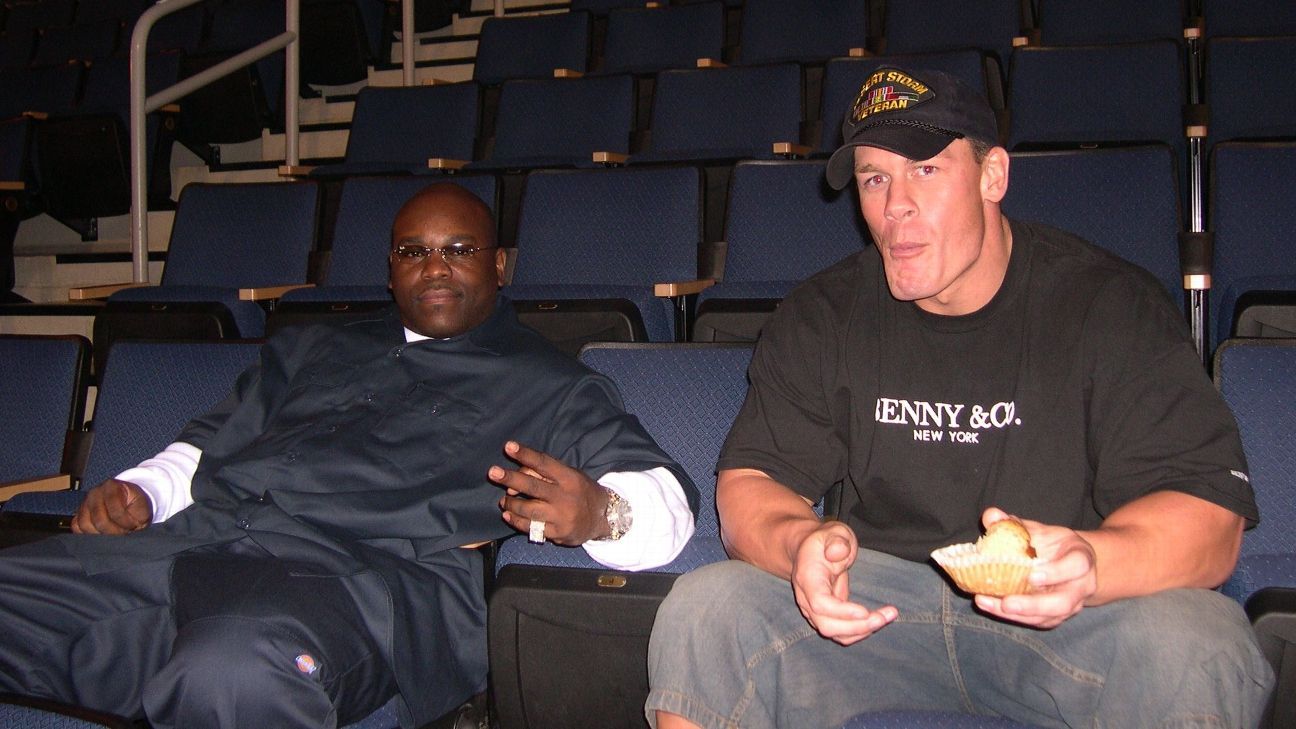
Bumpy Knuckles, recognized for his career in hip-hop, met Cena before an appearance on Hot 97 radio. Initially, Knuckles didn’t know Cena, but was surprised by his ability. While he gave his rhymes a “4 out of 10” rating, he believed he could become a “10” with his help. After exchanging numbers, they forged a relationship that culminated in Cena’s album.
Cena’s motivation for creating the album was dissatisfaction with the WWE rap music. “Maybe I can make better music than what they’re making for me in Connecticut,” Cena said. Thus, the seeds of “You Can’t See Me” were sown.John Cena’s “The Doctor of Thuganomics” character was more than just a gimmick.In the early 2000s, producer Jake One was looking for his big break. Although he had worked with artists like 50 Cent and De La Soul, his greatest success came from a CD he gave to a wrestler for his debut album. “I had no idea who John Cena was,” said Jake. He received $30,000 for three beats, and one of them became a cultural phenomenon: “The Time Is Now”.
The theme debuted on “SmackDown” on March 17, 2005. Although the song has generated much more money than it initially received, Jake One is grateful to be part of a key moment in Cena’s career. Despite the success, they still haven’t met personally.
“You Can’t See Me” was more than “The Time Is Now”. Cena, along with Trademarc, offered an album full of bravado and style. Unlike other forays into rap, Cena showed authenticity, from his rings to his witty rhymes. “It was part of me,” Cena said.
To create “You Can’t See Me”, Cena collaborated with underground rap figures, demonstrating his respect for the culture. Murs, a veteran of the California hip-hop scene, collaborated with Cena on the remix of “H-U-S-T-L-E” in 2004. Murs highlighted Cena’s authenticity and his commitment to the project.Rapper/producer Bumpy Knuckles was featured on four tracks with John Cena on “You Can’t See Me.”Campbell, who participated in four songs, helped shape the album. According to Campbell, Cena wasn’t looking to exploit the culture, but to learn and be authentic. They spent a lot of time together, from motorcycle rides to meeting influential figures in hip-hop. Campbell emphasized that he never wrote a rhyme for Cena, but was his companion to ensure his authenticity in the hip-hop world.
Ryan, who participated in the song “Beantown”, stated that the final result exceeded expectations. The album received positive reviews, highlighting Cena’s passion for both rap and wrestling.Boston rapper Esoteric worked with John Cena on his rap album in 2005.Two decades later, Cena’s image has changed. Although his iconic denim shorts are still present, his style has evolved into a more polished version. Cena acknowledged that he had to leave rap to adapt to new audiences.
Now, at 48 years old and near the end of his career, Cena has traded his jerseys for suits and Hollywood scripts. However, “You Can’t See Me” remains a triumph and a crucial moment in his career.
Campbell concludes: “I don’t think WWE told him to act like a rapper, I think John showed up like that. They just let him do his thing until the product and the audience changed and he had to do something different. He started playing the game, and he did it well, like a legend… Nobody can tell me anything bad about John Cena.”