In an ideal world, your favorite NFL team would retain all its key players with reasonable salaries, incorporate the best available players in free agency, and find hidden talents in the market. However, reality is often different. Although most teams can negotiate to keep their essential players, the salary cap forces even the best-managed teams to make difficult decisions. Organizations budget a specific amount for a player and must withdraw once expectations exceed their possibilities. A market with, for example, five viable young options in a position could be exhausted in a matter of hours, and teams that failed to secure their preferred options would have to look for a replacement among the remaining players. Free agency is a process that requires planning, but also the ability to adapt to circumstances. Analyzing team rosters and their situation one week into the 2026 league year, we identify the biggest weakness of each contender and how they might try to fix it, considering what remains in free agency and the habits of decision-makers.
Are there any starting-caliber free agents left on the market? Will these teams address their weak positions in the draft? Or are there other reasons to think a team might wait until later in the summer before making decisions?
To avoid having to make playoff predictions in mid-March, we will define contenders as the franchises that made the playoffs in 2024 or 2025, which leaves us with 20 teams. It’s time to start. (Teams are listed alphabetically within each division).
NFC East
Philadelphia EaglesWhat are they missing? Safety. Vic Fangio’s defense relies heavily on his safeties. They are asked to disguise their intentions and responsibilities before and after the snap, to read and adapt to route distribution, and to have a significant impact on run containment to help the light boxes that Fangio prefers to use up front. This doesn’t necessarily mean that Fangio needs Hall of Fame members in the back, but in the last 15 years, his defenses have had players like Dashon Goldson, Eddie Jackson, and Justin Simmons playing key roles at a high level. The 2024 defense, which was so dominant, won up front, but Reed Blankenship was a reliable coverage player, and C.J. Gardner-Johnson was the playmaker who generated big plays for the unit (six interceptions). Both are no longer there. Gardner-Johnson was replaced a year ago by Andrew Mukuba, who impressed for several stretches as a rookie before fracturing his ankle. Blankenship stayed one more year, but after a difficult season as a tackler, he left and signed a three-year contract with the Texans in free agency. Marcus Epps, who replaced the injured Mukuba, is also a free agent. There’s a potential option that could be very intriguing. Cooper DeJean worked a bit at the safety position during training camp a year ago. After the hiring of Riq Woolen this offseason, the Eagles could line up Woolen and Quinyon Mitchell at cornerback and use Mukuba and DeJean at safety when in their base defense. However, since the Eagles were in their base defense only 24.4% of the time, Fangio would still need a safety he trusts when DeJean returns to his usual role as the league’s best slot cornerback. The solution: Draft a safety. The Eagles are facing a financial crisis as they consider retaining A.J. Brown and Dallas Goedert. Even if the Eagles had a lot of space, there isn’t a safety worth spending a significant amount of money on in free agency, with veterans like Kyle Dugger and Donovan Wilson as the best available options. Those are players the Eagles could add at a reasonable price, but I’m not sure Fangio wants to commit to them as starters in 2026. Sydney Brown could be in the mix as an inside option, although the Eagles preferred Epps to their former third-round pick as Mukuba’s replacement last season. And general manager Howie Roseman could add a veteran like Xavier Woods, who has years of experience as a starter in Fangio-style defenses with the Panthers, but would likely figure as a backup safety and special teams player. It makes sense that Philadelphia would lean towards the draft as a place to find a new safety to play alongside Mukuba in nickel and dime packages.Washington CommandersWhat are they missing? Wide receiver. It’s been a tumultuous offseason for young quarterback Jayden Daniels, who lost offensive coordinator Kliff Kingsbury, and players like center Tyler Biadasz and, potentially, wide receiver Deebo Samuel after a frustrating 2025 campaign. The Commanders chose to promote 30-year-old assistant quarterbacks coach David Blough to replace Kingsbury, and have added players like Rachaad White, Jerome Ford and Chig Okonkwo as new playmakers. With Samuel still in free agency, general manager Adam Peters made moves to bolster the depth at the receiver position. The Commanders brought back Dyami Brown on a one-year deal after an unfortunate season in Jacksonville, then added Van Jefferson on another one-year deal. Treylon Burks flashed a bit in the second half after an injury-plagued start to his career in Tennessee, and there have been moments from 2024 draft picks Jaylin Lane and Luke McCaffrey. But there’s a steep drop-off on the depth chart from star Terry McLaurin to all other wide receivers. The solution: Add Brandon Aiyuk. The 49ers haven’t cut Aiyuk yet, hoping to get a trade for their former first-round pick, whose future is far from San Francisco after a strange 18 months. The 49ers voided Aiyuk’s guarantees after he refused to rehabilitate according to the team’s schedule, so while he is owed $26.2 million in 2026, that money is unlikely to go to the 27-year-old player.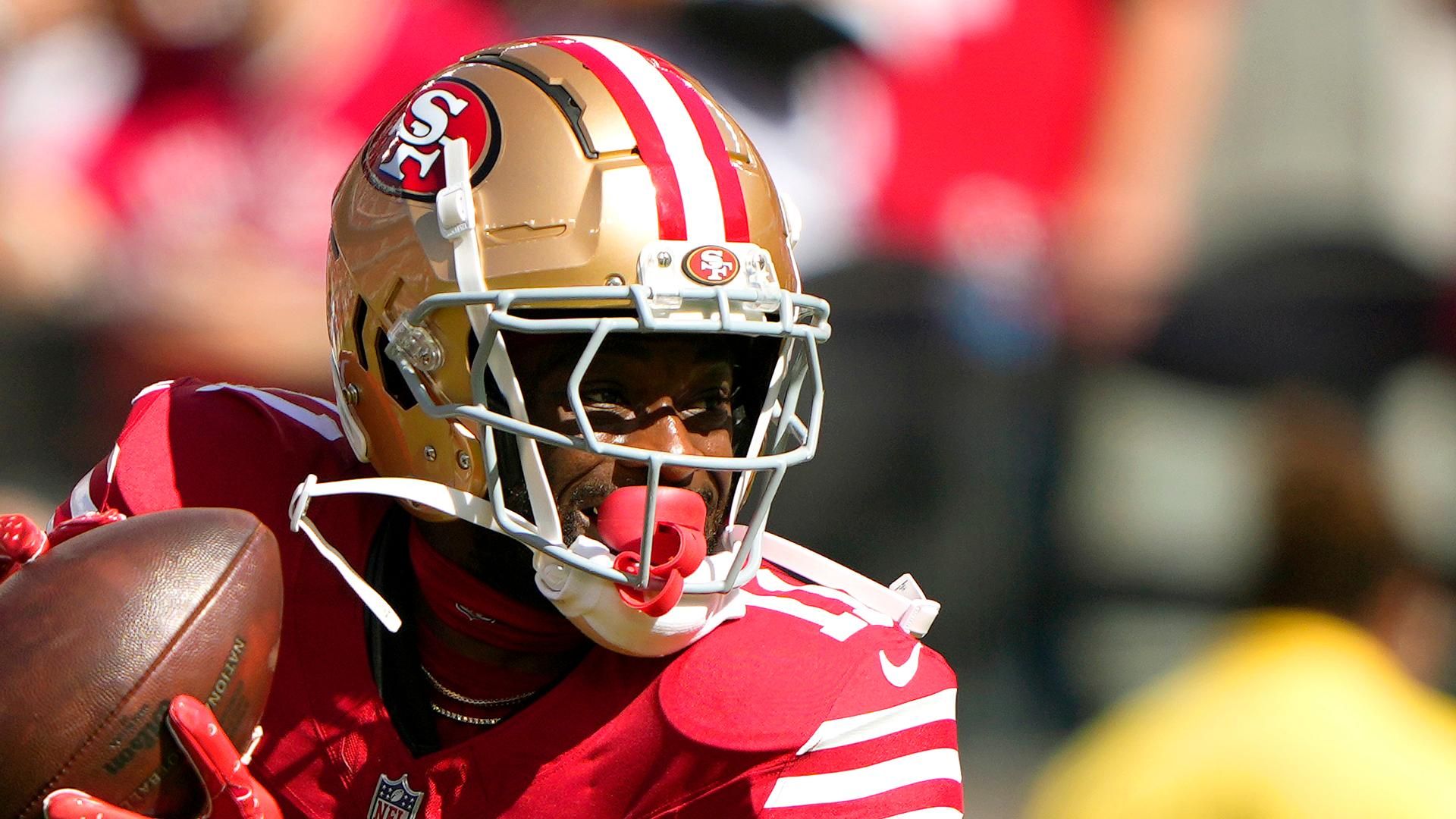
NFC North
Chicago Bears
What are they missing? Defensive back. While the Bears are coming off of winning the division title, general manager Ryan Poles hasn’t stood still. Drew Dalman’s unexpected retirement forced the Bears to acquire a replacement in Garrett Bradbury, but the Bears have been aggressive in making moves around their core. They traded DJ Moore and brought in a much more appropriate third receiver in Kalif Raymond. With Ozzy Trapilo out to start 2026, Poles brought back Braxton Jones and signed Jedrick Wills Jr. to compete as a short-term left tackle. On defense, however, there is still work to be done. Poles admitted the Bears were interested in trading for Maxx Crosby, and Chicago could still add another pass rusher. But for now, the search for a star edge rusher seems to be on the back burner. The Bears released Tremaine Edmunds and replaced him with former Browns starter Devin Bush, while safeties Jaquan Brisker, C.J. Gardner-Johnson and Kevin Byard III, the latter after a first-team All-Pro nomination, have been replaced by Super Bowl winner Coby Bryant and former Bills safety Cam Lewis. The Bears will start Bryant as their free safety, Kyler Gordon in the slot, and Jaylon Johnson on the outside, but there are still pieces to add in the secondary. Lewis is shaping up to be a dime safety instead of an every-down player. Tyrique Stevenson hasn’t been the same since that fateful Hail Mary against the Commanders in 2024. And although he started on the outside at the beginning of 2025, the Bears ended up preferring Nahshon Wright at the end of the season once everyone was healthy, with Stevenson ending up in a reserve role. Wright went to the Jets in the offseason, but Stevenson shouldn’t be guaranteed a starting spot in 2026. The Bears will probably still need to add a starting cornerback and a safety comfortable playing in the box between now and the start of the 2026 season. The solution: Take a chance on a veteran and add help in the draft. I thought the Bears might go after Alontae Taylor, who spent his first two seasons under Chicago defensive coordinator Dennis Allen in New Orleans, but the fifth-year pro signed with the Titans. Most starting-caliber young cornerbacks have already signed elsewhere, leaving the Bears without a plug-and-play option on the outside. The veteran cornerbacks who were going to be victims of the salary cap have already hit the market. They are not foolproof solutions. L’Jarius Sneed was excellent during his time in Kansas City, but struggled with injuries and had difficulties during his two years in Tennessee. And Allen is familiar with Marshon Lattimore from their time together with the Saints, but the former first-round pick was a disaster with the Commanders, missing a significant amount of time due to a hamstring injury after his 2024 trade and struggling a lot on the field before tearing his ACL in 2025. Trevon Diggs, who was cut by the Cowboys before the end of the 2025 campaign, hasn’t been the same player since his own ACL injury in 2023. The Bears could bring in one of those veterans on a one-year deal, but that would be to compete with Stevenson, not to replace him. Players like Tre’Davious White or Jeff Okudah could be more attractive. Chicago could also try to buy low on a disappointing young player like Kyu Blu Kelly or Kaiir Elam, hoping Allen can get more out of them than their previous teams did. While the Bears could look to address wide receiver and edge rusher early in the 2026 draft, the secondary should also be a priority. The good news for Poles is that the Bears have an extra second-round pick after trading Moore to the Bills.Detroit Lions
What are they missing? Edge rusher. This has been a very busy offseason for General Manager Brad Holmes, as the Lions have been forced to address some of the issues with their roster after a disappointing 2025 season. The Lions traded David Montgomery and added Isiah Pacheco, while the offensive line is in complete reconstruction after the departures of Taylor Decker and Graham Glasgow. Cade Mays was signed to start at center, and although the Lions hope Giovanni Manu can take over one of the tackle positions, it would be a shock if the Lions didn’t address their line in the 2026 draft. Edge rusher is also suddenly a concern. Aidan Hutchinson is securing a spot, of course, but the Lions are dangerously thin behind him. Al-Quadin Muhammad had a career year last season, accumulating 11 sacks and 20 tackles, but it seems telling that the Lions let the 30-year-old go for a one-year, $6 million deal with the Bucs. Holmes has repeatedly invested in former Saints first-round pick Marcus Davenport, but after missing 37 of 51 possible regular season games in the last three years with various injuries, Davenport doesn’t seem to be in Detroit’s plans for 2026. The Lions also cut Josh Paschal, who started most of the 2024 season before missing all of 2025 after undergoing back surgery. With Jahmyr Gibbs, Jack Campbell, Sam LaPorta, and Brian Branch eligible for extensions this offseason, Holmes will put most of his cash budget towards salary increases for some of his best young players. Is there anything left to fill the pantry beyond Hutchinson? The solution: Add in bulk. The Lions likely weren’t in a position to compete for players of the Jaelan Phillips and Odafe Oweh type in the 2026 market for financial reasons. They didn’t make runs at players like K’Lavon Chaisson or Arnold Ebiketie, who signed for more modest figures in the mid-tier of free agency, let alone meet with Muhammad. They have remained curiously quiet at their position of greatest need, and Detroit doesn’t have a third-round pick after sending their own third-round pick and a compensatory pick to the Lions as part of the Isaac TeSlaa draft trade last offseason. At this point, knowing that the Lions will likely need to reserve at least one of their top two picks for a left tackle, Holmes must address the edge rusher position with the idea that he needs to find multiple veterans who can contribute in situational roles. There is no full-time starter lurking on the market outside of Joey Bosa, who might be better in a rotational role given the way he played against the run last season in Buffalo. The good news is that there are still many veterans available. It is realistic to imagine the Lions building a rotation with someone like Bosa or Jadeveon Clowney.