

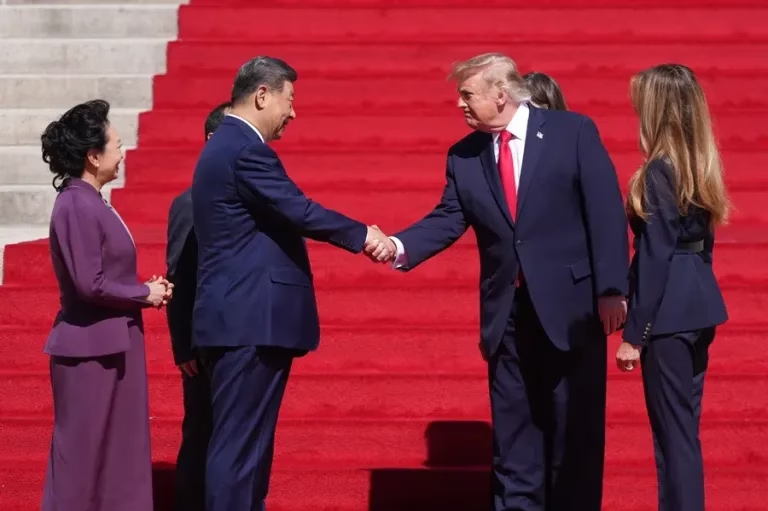
Key agreements between the United States and China: Superintelligence and trade cooperation
In a strategic move that marks a milestone in global diplomacy, China and the United States have formalized the establishment of a dialogue channel dedicated to superintelligence. This communication space will allow both powers to exchange perspectives on the benefits and risks derived from this emerging technology, an area where the competition for technological leadership is increasingly intense.
The agreement, reached during President Xi Jinping’s recent state visit to Washington, provides for the first official exchange of the so-called ‘US-China Superintelligence (SI) Dialogue’ for November 2026. In addition, both governments have agreed to create a specific bilateral channel for the management of incidents related to this technology.
While the US administration has shown a cautious stance toward regulation, the Chinese leadership emphasizes the importance of technology remaining under human control and being used for the benefit of the population.
Advances in the commercial sector
The strengthening of economic ties has been another pillar of the meetings. The Trade and Investment Councils between both nations have been activated, consolidating significant commercial commitments, among which the following stands out:
- China’s import of at least 10 million metric tons of U.S. coal for both 2027 and 2028.
- A consensus to apply preferential tariff treatment to non-sensitive goods worth $30 billion in both directions.
- A commitment to work together to regularize the supply of rare earths and critical minerals.
Safety and substance control
Regarding security, Washington urged Beijing to maintain a constant fight against fentanyl chemical precursors and to increase the production of petroleum products in order to stabilize global markets. For its part, the arms control agenda remains a priority issue, with proposals for trilateral negotiations that include Russia.
Although sensitive issues such as the situation in Taiwan were not detailed in the official statement, the meeting served to ratify a tariff truce that will extend until January. Both leaders have described the rapprochement as an opportunity to foster constructive competition and a stable bilateral relationship between the world’s two largest economies.


