Senate approves law to ban import of products made with forced labor
In a special session held in the municipality of Bonao, Monseñor Nouel province, the Senate of the Republic unanimously approved a bill that establishes strict measures to prevent and prohibit the entry into the country of goods produced through forced labor. The legislative piece, authored by Senator Félix Bautista, seeks to align the country with international standards and strengthen the competitiveness of the Dominican export sector.
Economic and competitive impact
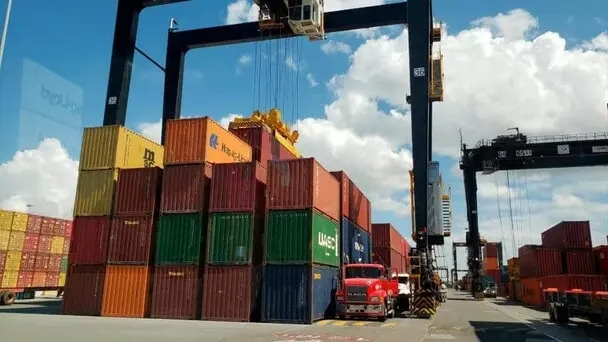
This regulation represents a strategic step for the national economy. Currently, the Dominican Republic was facing an additional 2.5% tariff in the U.S. market due to the absence of specific legislation on this matter. With the approval of this law, the Dominican Government is now authorized to manage the elimination of this extra tax, which amounts to approximately 180 million dollars annually, equivalent to approximately 10.8 billion pesos.
The approval of this legislation not only protects labor rights, but also provides a significant boost to our export sector, allowing us to compete on equal terms in the international market.
Senator Félix Bautista
Definition and application of the standard
The project defines forced labor as any work exacted under threat, penalty, or without the worker’s voluntary consent. For its identification, the law contemplates clear indicators of abuse, such as:
- Restriction of movement and isolation.
- Retention of identity documents or wages.
- Abusive working conditions and excessive overtime.
- Intimidation, physical or sexual violence.
- Abuse of vulnerability and deception.
Responsible institutions
The implementation and oversight of these regulations will be the responsibility of an inter-institutional body composed of the Ministry of Industry, Commerce and MSMEs (MICM), the Ministry of Foreign Affairs, the Ministry of Labor, and the General Directorate of Customs. These entities will be in charge of establishing action protocols and ensuring compliance with due diligence in supply chains.
The law is based on conventions 29 and 105 of the International Labour Organization (ILO) and on current trade agreements such as DR-CAFTA, reaffirming the Dominican State’s commitment to respect for human rights and fair trade practices.