Iran demands respect and an end to pressure to resume dialogue with the United States
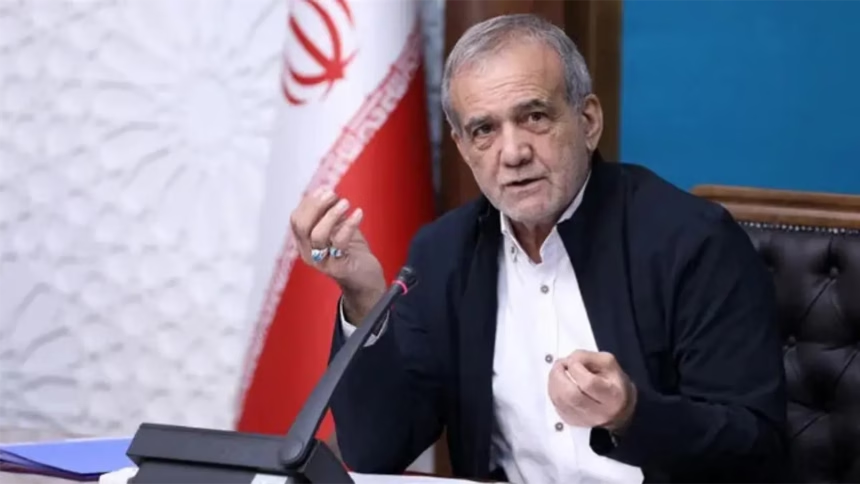
The President of Iran, Masoud Pezeshkian, has set a clear stance during the regional summit held in Turkmenistan: any attempt at negotiation with the United States is destined for stagnation if it is maintained under a climate of harassment and military threats. The Iranian leader emphasized that the path to peace requires a foundation of mutual respect and the fulfillment of reciprocal commitments.
Despite the diplomatic approaches recorded last month during the United Nations General Assembly, tensions between Washington and Tehran have not eased. The situation remains critical after seven months of a conflict marked by cross-attacks and deep mutual distrust.
Conditions for dialogue according to Tehran
Dialogue only makes sense and only has a chance of success if it is based on mutual respect and reciprocal commitments, and if it is free from all pressure and all threats.
Masoud Pezeshkian, President of Iran
Pezeshkian has been emphatic in pointing out that the economic sanctions imposed by the United States act as a direct brake on commercial and energy development, as well as on the stability of the entire region. For the Iranian leader, diplomacy is incompatible with the policy of constant pressure exerted by the White House.
The Strait of Hormuz and the diplomatic deadlock
One of the most critical points of the dispute is the control of the Strait of Hormuz, a vital artery for the global oil supply. Iran recently proposed the reopening of this route under a series of conditions, among which the lifting of U.S. economic sanctions stands out. However, the response from Washington has been one of rejection, maintaining uncertainty about the future of this strategic route.
- The U.S. government has conditioned future military actions, hinting that no attacks will occur before the November 3 legislative elections.
- Despite the pause in military operations since September, Washington has intensified sanctions against the Iranian aviation sector.
- The lack of progress on key regional security and economic issues continues to define the international agenda.
The current landscape reflects a scenario of uncertainty where, despite open communication channels, deep differences over sanctions and security in the Strait of Hormuz prevent reaching a lasting agreement that would allow for the normalization of relations between both powers.