

Tension at the UN: Guyana demands Venezuela comply with International Court ruling on the Essequibo
Within the framework of the 81st session of the United Nations General Assembly, the President of Guyana, Irfaan Ali, made a forceful call to the Venezuelan authorities to respect the decision that will be issued by the International Court of Justice (ICJ) regarding the territorial dispute over the Essequibo region. Ali stressed that this compliance is a fundamental obligation under the United Nations Charter, seeking to put an end to years of diplomatic uncertainty.
During his speech in New York, the Guyanese leader emphasized that his nation is committed to regional coexistence based on mutual respect. “We look forward to a new era of neighborly relations in the interest of our peoples, the development of our countries, and the stability and prosperity of our region,” Ali declared before the international assembly.
Differences in approach to conflict resolution
Ali’s speech emerges as a response to the position of the Venezuelan delegation, led by Delcy Rodríguez, who reaffirmed Venezuela’s historical rights over the Essequibo. While Caracas insists that the solution must be reached through direct bilateral negotiations, Georgetown maintains that the judicial route is the only viable path after decades of failed attempts through other diplomatic channels.
Recourse to the ICJ came after decades of efforts to resolve the controversy bilaterally, including through a joint commission and the good offices of the Secretary-General of the United Nations. With full respect for international law, Guyana participated and encouraged Venezuela to participate in the ICJ proceedings.
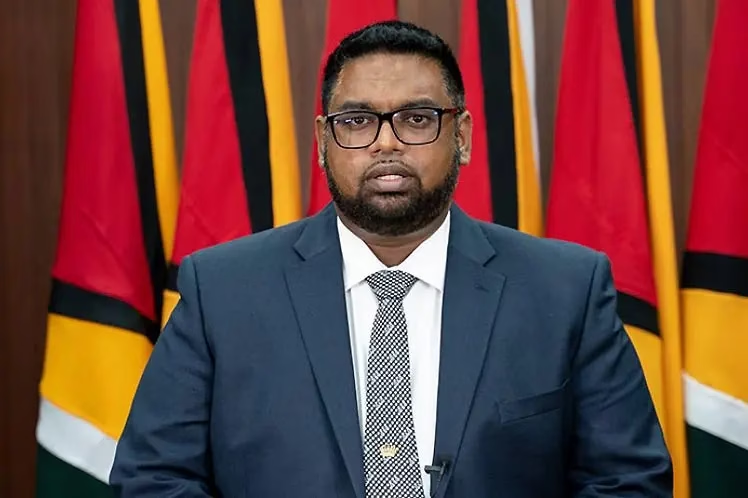
Irfaan Ali, President of Guyana
Historical context of the dispute
- Paris Arbitral Award (1899): Guyana considers it the legal basis that defined the border in a definitive and binding manner.
- Geneva Agreement (1966): It is the instrument that Venezuela uses to question the validity of the previous award and advocate for a negotiated solution.
- Legal action: In 2018, Guyana filed a lawsuit before the ICJ to legally validate the 1899 award, a process that Venezuela has repeatedly opposed by questioning the court’s jurisdiction.
The disputed region, which covers approximately 160,000 square kilometers, remains the central point of diplomatic friction. President Ali insisted that his government maintains an unwavering commitment to peace, despite what he described as constant provocations in the border area. The international community remains expectant of the definitive measures that the ICJ determines regarding the merits of this historic case.


