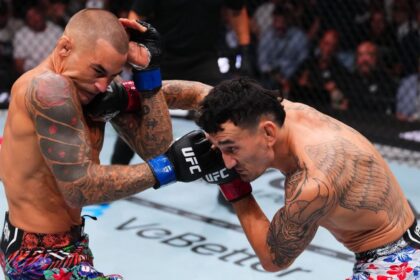

The Origin of the BMF Title: A Story of Rebellion and Authenticity in the UFC
The world of mixed martial arts (MMA) is preparing for a new chapter in the history of the BMF (Baddest Motherf***er) title this Saturday at UFC 326. The expected fight, which promises strong emotions, will pit two figures beloved by the fans against each other: Max Holloway and Charles Oliveira. The story of the BMF title dates back to UFC 241 in 2019, when Nate Diaz defeated Anthony Pettis. After his victory, Diaz issued a challenge to Jorge Masvidal, seeking the belt that represented the “baddest motherfucker in the game”. Dana White, UFC CEO, took note of that moment and decided to create a physical belt for the fight between Diaz and Masvidal at UFC 244. Since then, the BMF title has become one of the UFC’s most successful marketing strategies, reserved for the fiercest and most exciting fighters: Diaz, Masvidal, Justin Gaethje, Dustin Poirier, Holloway, and Oliveira. Although the UFC is the official entity that registers the BMF title, its true history lies in the origins of Nate Diaz, in Stockton, California. Diaz transformed his experiences in the world of fighting into the unique honor that the title represents, defining it as “the moral code of the fight game”.The BMF Code: A Matter of Attitude
For Nate Diaz, the BMF story began with his older brother, Nick. Nick always had a defiant attitude and an indomitable spirit, which led him to excel both in life and in sports. Nick, like Nate, brought that mentality to the world of professional fighting, earning the affection of fans for his unique and provocative style. Nick won a championship in Strikeforce in 2010 and became a star of the sport, creating his “Nick Diaz Army”, which included teammates like Gilbert Melendez and Jake Shields. Nate, who signed with the UFC in 2007, aspired to emulate them. Nate faced a different path than his brother and teammates, with more opponents focused on grappling than striking. Despite earning bonuses on six occasions, his UFC record was mixed. Diaz didn’t feel comfortable “fighting for points,” as it didn’t represent the BMF spirit.In 2012, Nate had his only chance at a UFC title, losing by decision to Benson Henderson, who controlled him on the ground for much of the fight. After that defeat, Nate changed his focus, setting aside the pursuit of a UFC belt and adopting a new philosophy. His new strategy, of only accepting fights against rivals who met his criteria, put him at odds with the UFC on several occasions. As a result, he remained inactive for much of 2014 and 2015, and was not satisfied with his contract. The UFC promoted another fighter the way Diaz felt he deserved: Conor McGregor. While Diaz was frustrated, McGregor became a superstar. Diaz felt that the company treated him like a pawn in the lightweight division, while crowning McGregor as king. A week after McGregor defeated José Aldo, Diaz won by unanimous decision against Michael Johnson, leading to one of the most infamous post-fight interviews in history. The BMF title didn’t come up in that speech, but the rules that govern it did. Someone had entered the same space as Diaz and acted like he was the toughest, and Diaz had reacted. Diaz and McGregor starred in two epic fights. Neither of those fights appear in the BMF record, but that’s exactly what they were. From Diaz’s perspective, once his rivalry with McGregor ended, the UFC went back to normal in terms of his career. Diaz wanted opportunities that were just as big and unique, but they didn’t materialize. He ended up sidelined for three years, waiting for the right fight to happen. And then, out of nowhere, Jorge Masvidal appeared. Masvidal, a street fighter turned veteran contender, achieved the fastest knockout in UFC history, with a flying knee in five seconds against Ben Askren at UFC 239 in July 2019. That moment encapsulated everything Diaz was looking for in an opponent. Masvidal had proven his worth time and again, just like Diaz. It was the perfect matchup. So perfect that Diaz couldn’t believe the MMA world wasn’t clamoring for it. Diaz and Masvidal faced off, with Diaz offering to defend his BMF belt against Masvidal, who was present at the event. Less than four weeks later, the fight between Diaz and Masvidal was announced as the main event of the UFC at Madison Square Garden. The BMF title became a big spectacle in UFC history. The inaugural event attracted over 20,000 people and generated $6.5 million in box office revenue, the highest in the UFC that year. Dwayne “The Rock” Johnson presented the BMF title. Donald Trump attended, marking the first appearance of a United States president at a UFC event. Diaz lost to Masvidal by medical stoppage after the third round, but the BMF concept he introduced to the MMA world has endured. The title has its detractors, but it has attracted champions who have requested to fight for it. For Diaz, the lasting power of the title is a source of pride and a validation of his belief in the moral code of the fight game. At 40 years old, Diaz, who left the UFC in 2022 to explore other options, suggests he might return to the octagon to show everyone where all this comes from.“Those guys were taking the lead fighting, but they got tired in the third round and Nate was just getting started, destroying them,” Melendez commented. “Those kinds of fights, it doesn’t feel like a loss. He would say, ‘I didn’t lose that shit, I just ran out of time.’ And he was right, he just ran out of time.”
Gilbert Melendez