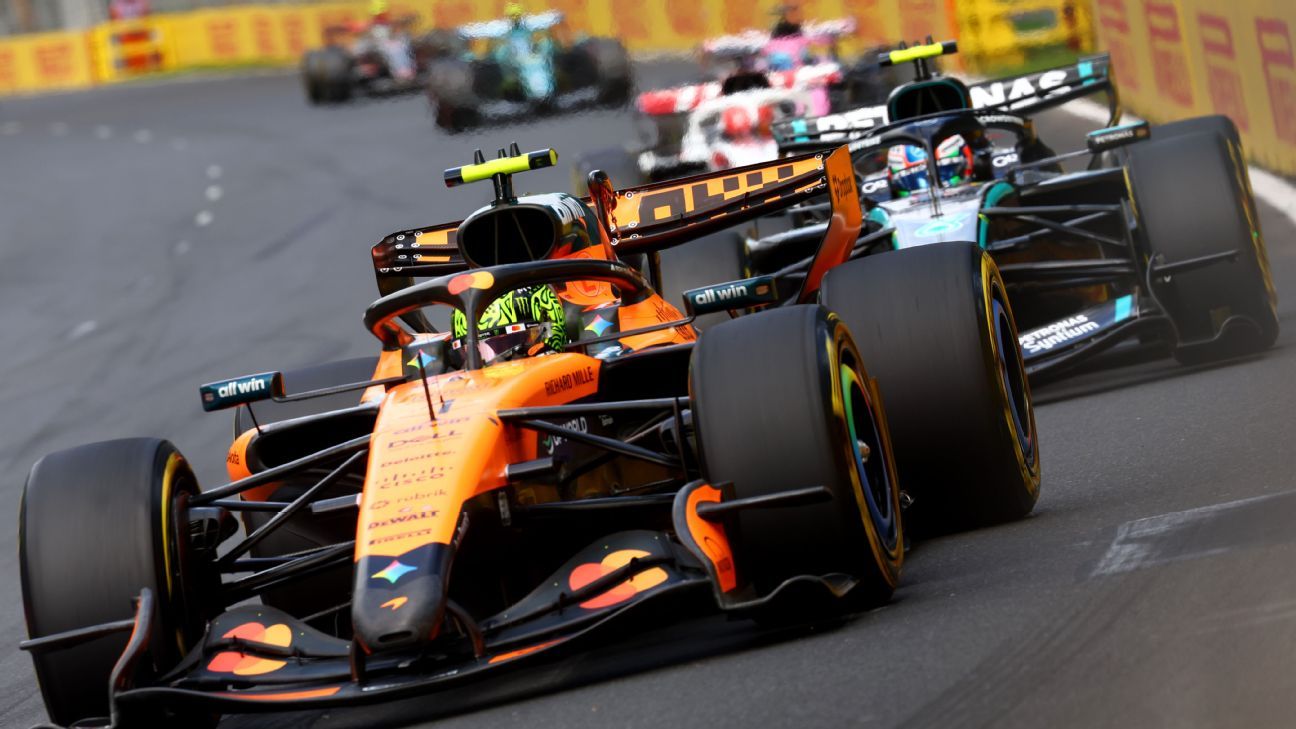
McLaren Seeks to Improve Communication with Mercedes to Optimize Performance
The McLaren team has expressed its concern about the flow of information from its engine supplier, Mercedes, under the new Formula 1 regulations. This situation has affected its ability to exploit the full potential of its power unit in the current season.
In the first race of the season in Australia, McLaren qualified 0.8 seconds behind George Russell’s pole position and finished the race more than 50 seconds behind the leading Mercedes.
McLaren, along with Williams and Alpine, are Mercedes engine customers this year and have started the season behind the official team, which seems to be the strongest in the field according to the first race.
Engine suppliers in F1 are obliged to offer the same hardware to their customers, but with the new 2026 regulations, much of the performance is linked to how the hybrid system of the power unit is operated.
Although McLaren has the same power unit, it considers that it is still far from understanding how to extract the same potential as the official Mercedes team.
We have work to do to exploit the potential of the power unit, which, when I see the potential that HPP (Mercedes High Performance Powertrains) is extracting, it seems there is more available.
Andrea Stella, McLaren team principal
Stella added that the collaboration with HPP will intensify, as they believe there is significant room for improvement.
Although the official Mercedes team is not obliged to share its secrets with McLaren, Stella indicated that the flow of information from the Mercedes engine department has not met his team’s expectations.
Stella revealed that McLaren has already expressed its concerns to its engine supplier.
“The discussion with HPP about having more information has been ongoing for weeks,” he stated. “Because even in the tests, we practically went out on the track, analyzed the data and said ‘oh, this is what we have, okay, now we have to react to what we have.'”
“But that’s not how you work in Formula 1. In Formula 1, what happens on the track, you simulate [before], you know what’s happening, you know what you’re programming, you know how the car is going to behave.”
«So you also have your plans on how to evolve it, which you have devised before because you know what you expect from the car. Therefore, I have to say that, as we are a customer team, it is the first time we feel that we are at a disadvantage, even with regard to the ability to predict how the car will behave and the ability to anticipate how we can improve the car.»
McLaren outperformed Mercedes at the end of the previous rules cycle, but the operating parameters of the previous generation of power units were well understood and had less impact on overall performance.
The additional emphasis on electrical energy under the new rules means that a difference in the approach to a curve can have a significant impact on a complete lap.
«There’s one more factor, and this is perhaps useful for you to understand what kind of Formula 1 we are experiencing», added Stella. «Everything is very sensitive.»
«Why are tools important? Because you can change the amount of ‘lift and coast’ before turn 1 and this affects the deployment throughout the lap, which also bewilders the drivers when they have to optimize driving, the battery, because this is now a fundamental way of driving a Formula 1, you are driving the battery.»
«Therefore, when everything is so sensitive, the dependence on the tools is even more important. Like last year, where everything was calmer in terms of power unit behavior and electrical energy deployment, we had the tools, but we didn’t depend on them so much.»
«But now it’s practically about the tools because changing a detail in one place affects something much bigger in a place very far from the circuit, which is difficult to predict.»
Williams team principal James Vowles reported a similar disconnect between his team’s understanding of the Mercedes power unit and that of the official team.
“What Mercedes is doing with the power unit is something that took us by surprise,” Vowles said before Sunday’s race. “It took us a qualifying session to realize how far behind we are. In that sense, we’re probably three tenths [of a second from the engine] short, something like that.”
Vowles, who left Mercedes to join Williams in 2022, said he also expected Mercedes’ engine department to be more open about its leading power unit.
«I expected it to some extent, yes. That’s why I said I was surprised yesterday.»
«It’s not an open door, as one might imagine, because that’s where the performance is. So it’s up to us to try to fix it.»
«We have to recognize that we, as Williams, do not have the sophistication that they have in other technologies, and that definitely depends on us. I would say that the opposite is that there is certain inherent knowledge that they have and that we do not. And that depends on us to discover it.»